Web Content Manager & Technical SEO — Buenos Aires
Five years managing Salesforce’s global site taught me where sites break, and how to fix them. I’m now building on that with technical SEO audits, helping companies improve organic visibility, search architecture and the technical performance of their pages.
For the past five years, I’ve worked on web projects of every size, from small sites to mid-size ones and enterprise-scale platforms, across CMS like WordPress, Drupal, Adobe Experience Manager and Salesforce Page Builder.
I spent the last few years at Salesforce, as a Web Experience Producer, working on both the Salesforce.com and MuleSoft.com sites. I coordinated with teams across different areas on publishing and updating content, plus general site maintenance.
After years on the technical side of content management, I found myself increasingly drawn to SEO, technical SEO especially. I like finding what’s wrong with a site, tracking it down, and fixing it.
Today I bring that technical SEO lens to my web production work.
5+ years
In web projects
500+
Pages worked on
6+
International locales
02
Work
Technical audits, enterprise CMS work and tools of my own.
01Technical audit · Self-directed
B2B SaaS Platform
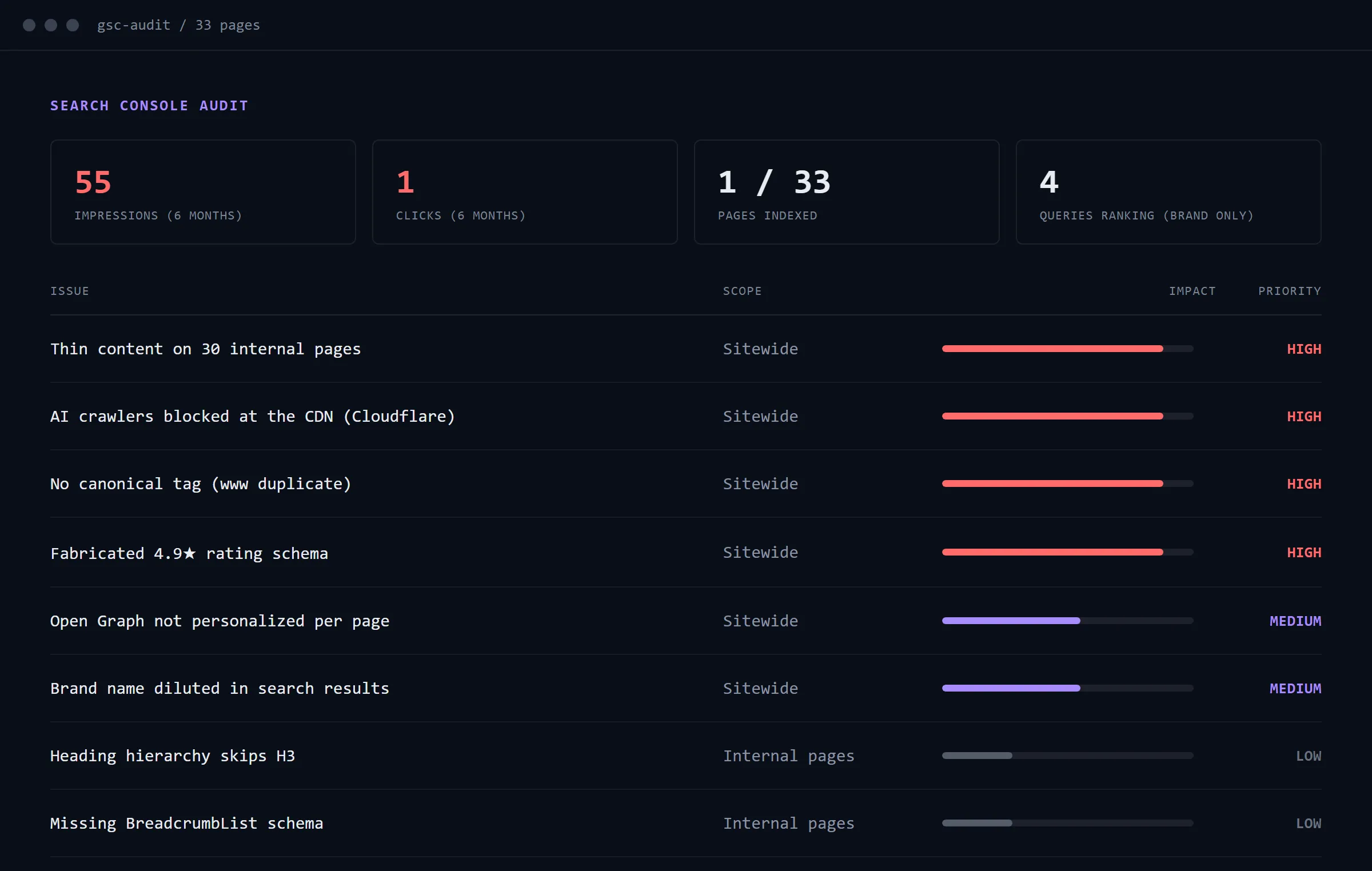
A technical SEO audit of a B2B SaaS platform with real Google Search Console data: 55 impressions and 1 click in 6 months, with only 1 of 33 pages indexed. I audited GSC data and PageSpeed Insights, then reviewed the source code of the homepage, a key internal page, robots.txt, sitemap.xml and llms.txt to find what was blocking indexing and AI crawler access.
What I found
30 of 33 pages stuck as 'discovered, not indexed': not a technical block, just too little text for Google to trust on a new domain
Cloudflare silently blocking every major AI crawler (GPTBot, ClaudeBot, PerplexityBot), so well-written llms.txt files were never being read
A fabricated 4.9-star, 47-review rating baked into every page's schema, with no matching reviews on any public platform
What I delivered
Root-cause analysis tying 30 unindexed pages to one fixable content gap, not a crawl or index block
A 7-step action plan split into 'this week' and 'next 2-3 weeks' phases
A clear split between Google Search fixes and AI-visibility fixes, since they need different owners and timelines
Google Search ConsolePageSpeed InsightsSource Code Audit
Search Console audit — indexability and AI-crawler visibility
02Technical audit · Self-directed
Document Digitization Company
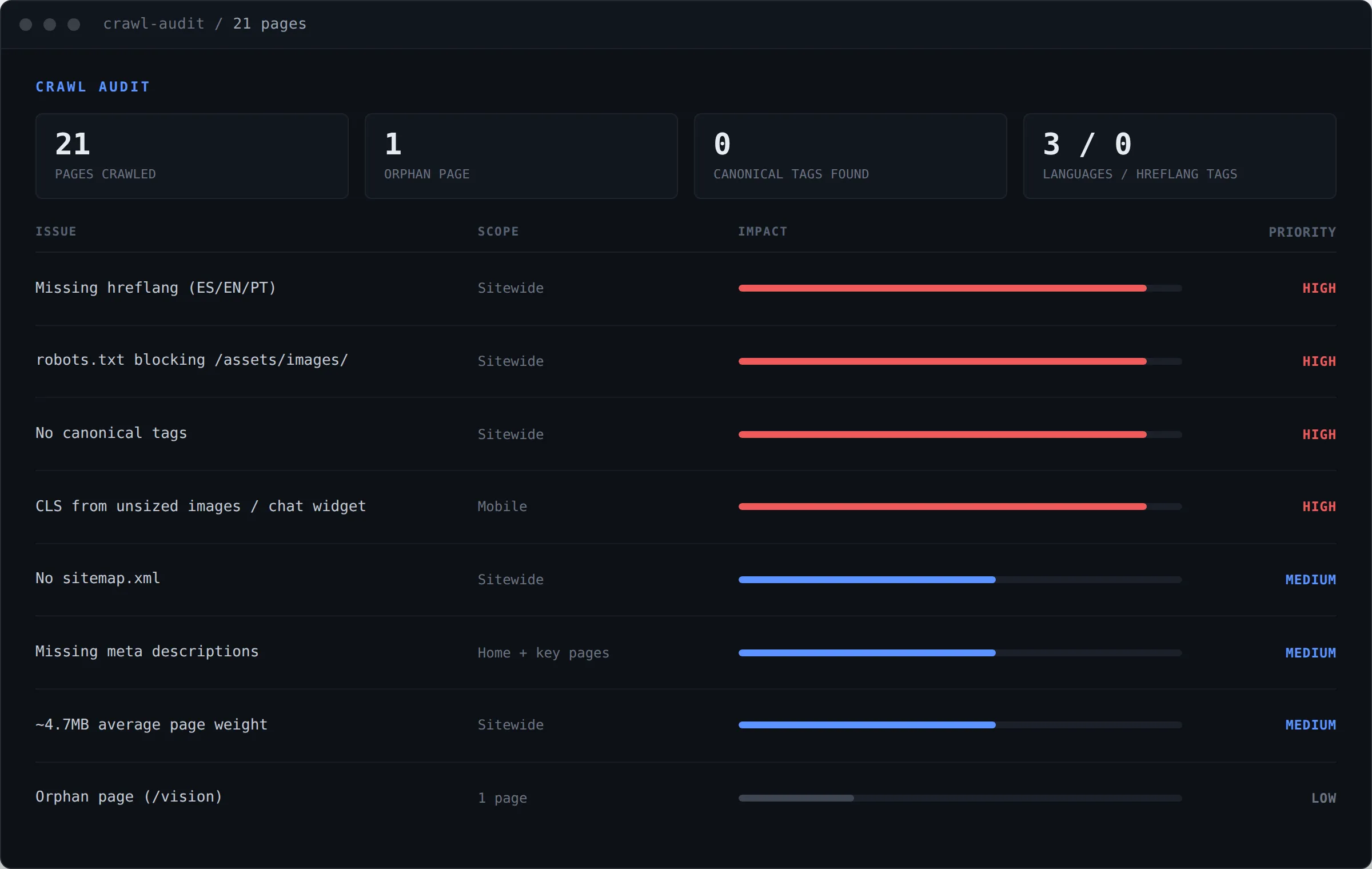
A technical SEO audit of a 21-page multilingual WordPress site (Spanish, English, Portuguese) for a B2B document digitization company. Crawled with Screaming Frog and cross-checked against Google's index with site: search, then audited for performance with PageSpeed Insights and Chrome DevTools. Findings are ranked by SEO impact, indexability and international duplication first, on-page and performance after.
What I found
Zero hreflang tags across three language versions, creating duplicate-content risk internationally
A robots.txt rule blocking /assets/images/, keeping product images out of the crawl
No canonical tags anywhere on the site, homepage included
What I delivered
An 8-phase technical report, from crawlability to internal linking
Ready-to-implement fixes, including hreflang markup for all three locales
A prioritized performance plan split into high-priority and secondary fixes
Screaming FrogPageSpeed InsightsChrome DevTools
Crawl audit — prioritized fix queue
03Automation · Google Apps Script
Team Availability Bot
On a 35+ person, four-country team at Salesforce, there was no shared view of who was out and when, so everyone had to check around manually. I proposed and independently built a Slack bot that reads the team's calendars and posts an automatic weekly digest. The team adopted it as the standard way to track availability.
The problem
No shared view of who was out, across a distributed team
Availability tracked manually, person by person
No easy way to plan around it as a team
The solution
Proposed and independently built a Slack bot for the team
Automatic weekly digest, no manual check-ins
Adopted as the team's standard for tracking availability
Neither I nor the people around me had a quick way to see who doesn't follow back on Instagram, and none of the apps on the Play Store or App Store were reliable, so I built my own. Since there's no public API for this, it works off the two files Instagram itself lets you export, entirely client side: no backend, nothing uploaded.
I joined the Growth Marketing Team on Salesforce.com's Core Team. Alongside Customer Stories and Campaign pages, I worked on the site's global navigation and on continuously improving the CMS itself, testing new features and improvements before they went live.
Scope
Point of contact for Customer Story production, intake to publish
100+ pages managed on the US site
Custom CSS/HTML overrides when the CMS templates weren't enough
Shipped
14+ story suites shipped, including FedEx and Pandora
8+ campaign and lead-gen pages, including Formula 1/VCARB and FIFA sponsorships
Multi-region AEM migration, webinar pages launched across 6 locales
I worked across mulesoft.com's Products, Solutions, blog, Customer Stories and gated assets, and owned Content Monitoring, reviewing potential site issues. I was also a core contributor to the site's migration from Drupal to Salesforce Page Builder, helping ship its first native Page Builder page, and tested pages before they went live.
Scope
Content Monitoring owner for mulesoft.com
Core contributor to the Drupal → Page Builder migration
Localization across 6 English-locale environments
Shipped
345 URLs restructured for SEO topic hubs
368 pages delivered, 89 requests completed in one quarter
Key product pages, including MuleSoft for Agentforce
DrupalSEOMigration
MuleSoft.com
03
Let’s talk
If you’re hiring for your team, or just want to know more about me, get in touch.